
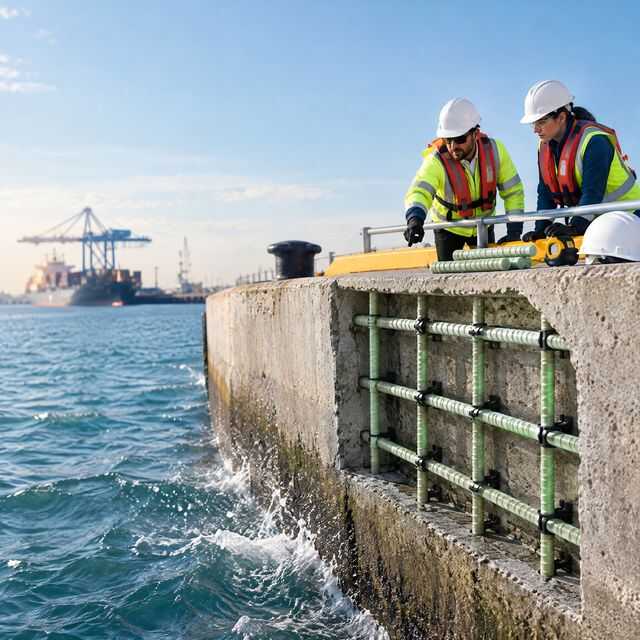
GFRP Rebar in Marine Construction: Solutions for Saltwater Environments

**GFRP rebar in marine construction** offers a direct answer to the main cause of damage in coastal concrete: chloride-induced corrosion. In saltwater, splash zones and tidal environments, chlorides penetrate the concrete and corrode steel reinforcement. The rust expands, cracks the concrete and shortens the structure’s service life. GFRP rebar contains no metal, so it doesn’t rust, and it is not affected by chlorides in the same way. That makes it a strong candidate for piers, quays, seawalls, breakwaters, jetties, docks, boat ramps, desalination plants and other coastal infrastructure. Its lighter weight also makes it easier to handle and place on site. It is non-conductive and non-magnetic, which helps near ports, cathodic protection systems and electrically sensitive equipment. GFRP does have limits. It has a different elastic modulus from steel and no yield point, and long-term performance depends on the resin, the fiber quality and the alkaline environment inside concrete. Concrete cover, crack-width limits, development lengths and durability reduction factors must therefore be set by a licensed structural engineer under the applicable code. Bends and stirrups must be factory-made, because bars can’t be bent on site. Manufacturer claims of strength above steel, roughly 80% lower weight and 100% corrosion resistance should be verified against test certificates, such as long-term durability tests in alkaline and saline conditions, and against local standards before relying on them in design or pricing. More at [7stargfrp.com](https://www.7stargfrp.com/).