Rathi Group
Rathi Group: Industrial Expertise and Advanced Reinforcement Solutions for Construction and Infrastructure
Established steel industry experience combined with advanced GFRP reinforcement technology for durable, efficient, and application-specific construction solutions.
Modern Reinforcement for Modern Infrastructure
Modern construction requires more than structural strength. Engineers and developers must also consider durability, environmental exposure, construction efficiency, and maintenance throughout a structure’s service life. Rathi Group, through its steel operations and Rathi 7 Star GFRP products, combines established industrial experience with composite reinforcement technology.
This combination expands the options available to designers and contractors, particularly where corrosion, reinforcement weight, and maintenance access are important considerations.
The engineering value of these solutions lies in selecting the appropriate material for each application, supported by verified product properties, suitable design methods, and consistent manufacturing quality.
Rathi Group: Industrial Heritage and Business Activities
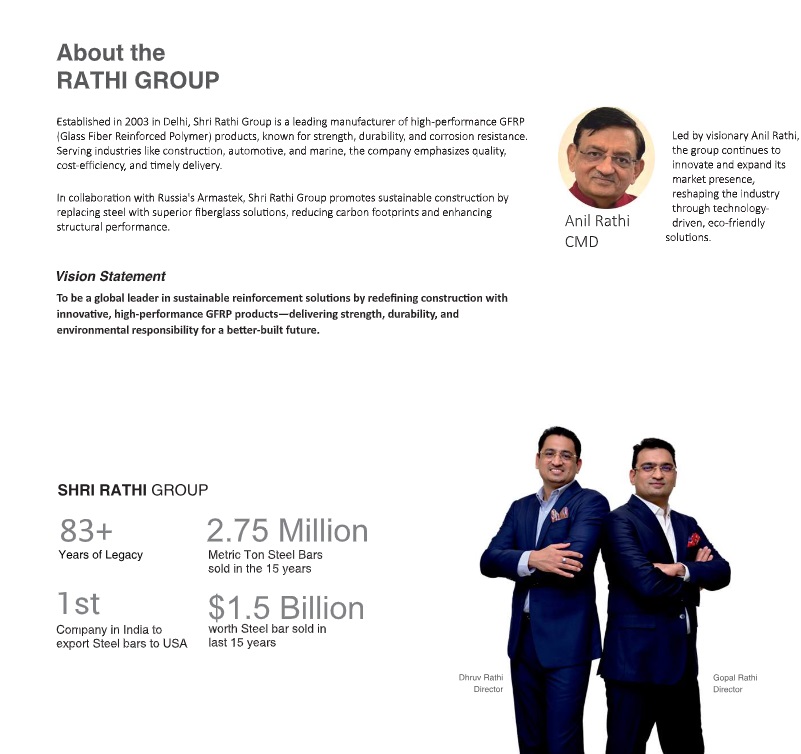
Shri Rathi Group operates in the steel and composite materials sectors, with an emphasis on quality, cost efficiency, and delivery. Its catalogue describes a corporate establishment in Delhi in 2003 alongside a considerably longer industrial heritage. These represent distinct milestones and should not be interpreted as the same period of corporate operation.
Industrial Experience and Scale
According to the company’s catalogue, the group’s industrial heritage exceeds 83 years. It also reports sales of approximately 2.75 million metric tonnes of steel bars, valued at approximately USD 1.5 billion, over a period of 15 years.
These are company reported figures relating to steel operations and industrial heritage. They do not represent GFRP production volumes or the duration of composite reinforcement manufacturing.
From Steel Reinforcement to Composite Materials
The group’s activities include TMT steel reinforcement bars, which undergo thermomechanical treatment to develop a combination of strength and ductility.
Alongside this business, Rathi has expanded into fibre reinforced polymer products and presents a technological collaboration with Armastek.
This broader product offering supports material selection according to project requirements. Steel remains a fundamental reinforcement material, while GFRP provides an additional option where its specific properties offer engineering and economic advantages.
GFRP Technology and the Product Portfolio
Rathi 7 Star GFRP offers reinforcement products manufactured from glass fibre reinforced polymer. This composite combines continuous glass fibres with a polymer matrix.
The fibres carry most of the tensile load along their orientation. The matrix binds the fibres, transfers stresses between them, and helps protect them from environmental exposure.
Material Structure and Manufacturing
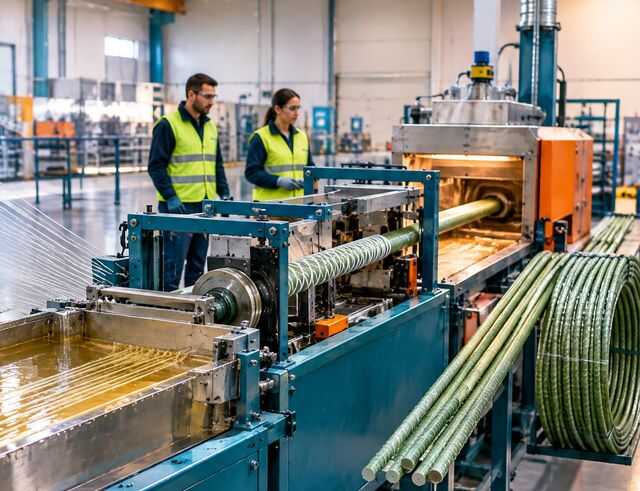
Straight composite reinforcement can be manufactured through pultrusion, a continuous process in which fibres are impregnated with resin, formed into the required section, and cured under controlled conditions.
Performance depends on fibre and resin selection, fibre content, impregnation quality, and curing conditions. Surface geometry and treatment also influence the transfer of forces between reinforcement and concrete.
GFRP is a material category, not a single performance specification. Each product must therefore be assessed using its own technical documentation and test results.
Reinforcement Bars
GFRP bars provide tensile reinforcement in concrete applications designed for their particular mechanical properties. Potential applications include slabs, precast elements, and infrastructure components exposed to aggressive environments.
Replacing steel with GFRP is not a direct substitution based on equal bar diameter. Reinforcement area, spacing, development length, and serviceability requirements must be calculated using the applicable design provisions.
Mesh and Bent Elements
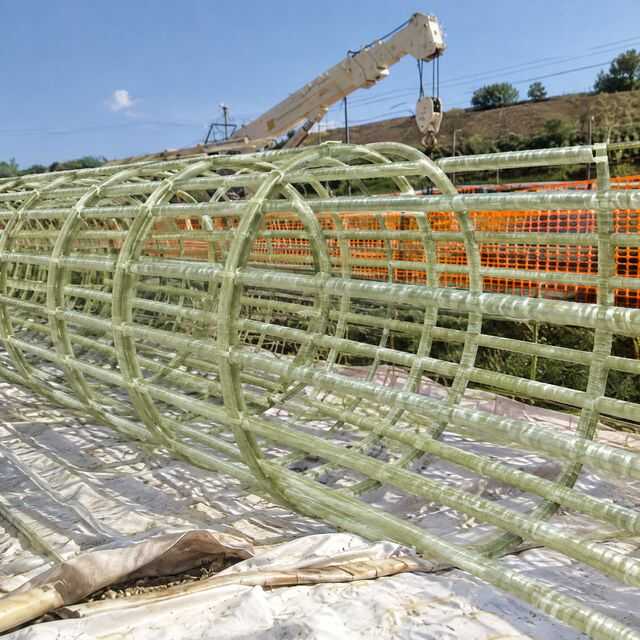
GFRP mesh provides reinforcement in predefined arrangements and may simplify placement in suitable concrete elements. Its low weight can facilitate handling, but adequate supports and restraints remain necessary during concrete placement.
Bent elements are manufactured to specified geometries. Conventional GFRP products using thermosetting resins cannot be bent on site in the same manner as steel.
Bend radii, dimensions, and anchorage details must be established in advance. The capacity of bent regions also requires specific assessment, rather than reliance on straight bar tensile strength.
Engineering Advantages and Application Areas
Composite reinforcement delivers the greatest value when its properties address identifiable project risks or operational requirements.
Resistance to Reinforcement Corrosion
Moisture and chloride ingress can initiate corrosion in steel reinforcement, potentially causing concrete cracking, cover delamination, and repair requirements.
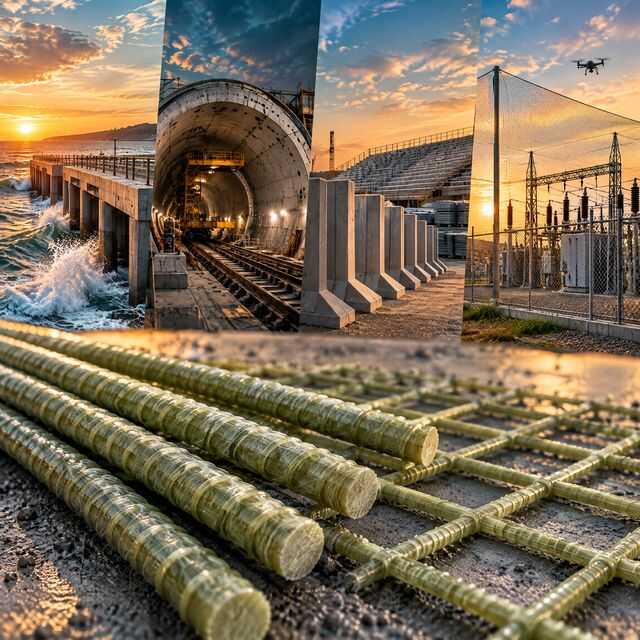
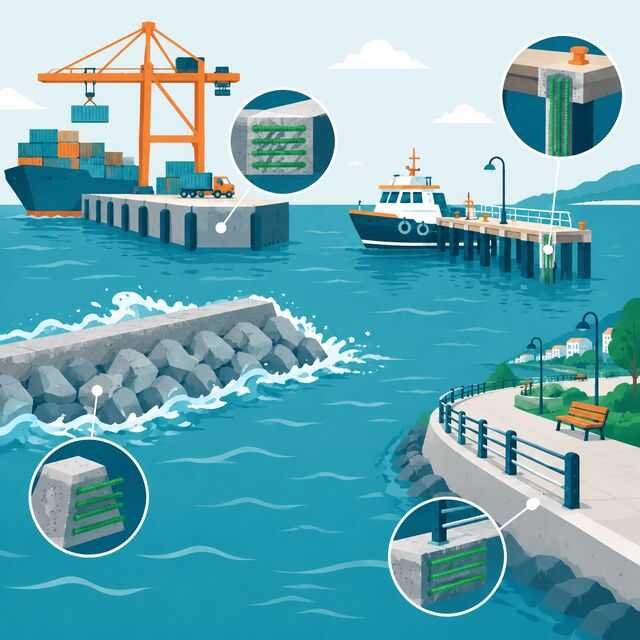
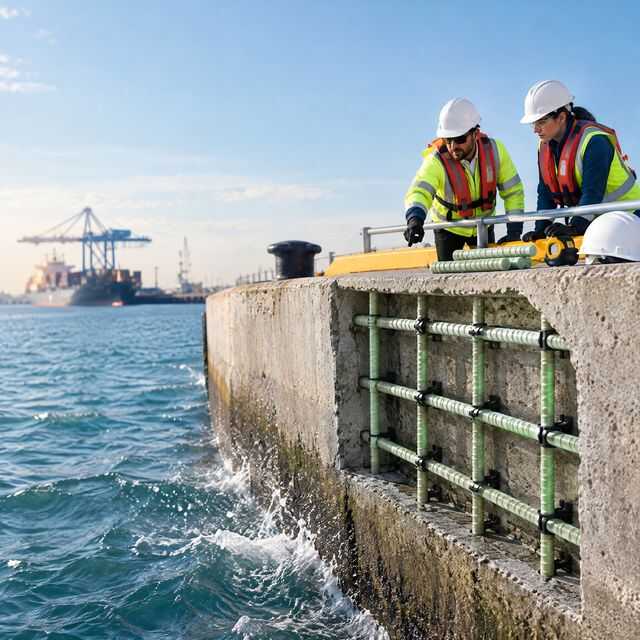
GFRP does not rust through the electrochemical mechanism associated with steel. This makes it relevant to coastal infrastructure, marine facilities, water structures, swimming pools, and elements exposed to salts.
However, resistance to rust does not mean immunity to every degradation mechanism. Durability must still be assessed against concrete alkalinity, moisture, temperature, and relevant chemicals.
Low Weight and High Tensile Strength
The catalogue advertises weight reductions of up to approximately 80 percent compared with steel. This comparison must be interpreted on a defined basis, such as equal volume or similar dimensions. It does not automatically represent the reduction in total reinforcement weight for an equivalent structural design.
Lower weight can improve handling, unloading, and movement around restricted sites.
GFRP can also provide high longitudinal tensile strength. However, its elastic modulus is generally lower than that of reinforcing steel. Consequently, deflection and crack width may govern design even where tensile capacity is sufficient.
Infrastructure and Specialist Applications
The catalogue identifies potential applications in roads, bridges, retaining walls, floors, channels, industrial facilities, and precast concrete.
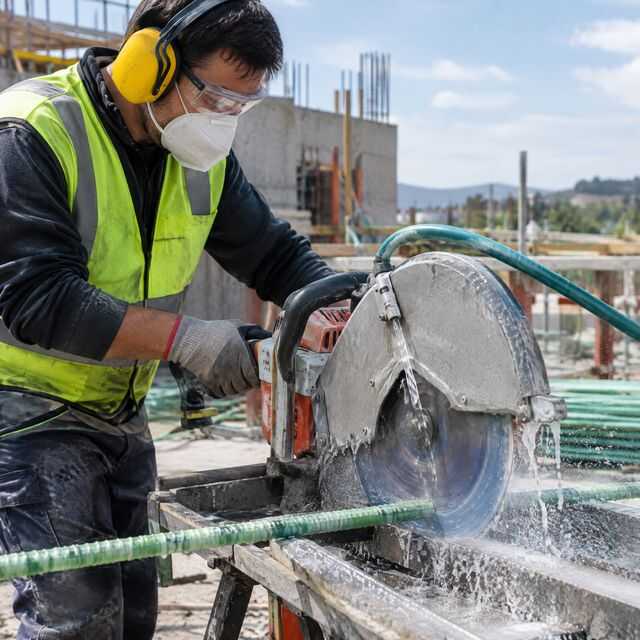
In tunnelling, GFRP may be considered for designated zones intended to be cut by tunnel boring equipment, subject to appropriate structural design.
Its nonmetallic characteristics may also benefit facilities requiring reduced magnetic interference or electrical conductivity. Suitability must be confirmed against the requirements of the installation and the properties of the specific product.
International Technology Experience
The catalogue describes GFRP use in more than 60 countries and includes examples of FRP applications in North American bridges.
These examples illustrate the international development of composite reinforcement technology. They should not automatically be interpreted as projects supplied by Rathi or as evidence of approval for a particular local application.
Design Verification, Economic Assessment, and Regional Representation
Successful implementation requires coordination between the manufacturer, structural designer, contractor, and relevant approval bodies.
Whole Life Economic Assessment
A meaningful cost comparison includes material prices, designed quantities, transportation, installation, maintenance, and disruption associated with future repairs.
Where corrosion is expected to generate substantial maintenance expenditure, GFRP may offer a lifecycle advantage. Advertised savings should nevertheless be validated for each project.
Environmental comparisons similarly require lifecycle assessment, including manufacturing, transport, service life, maintenance, and disposal. Lower weight alone does not establish overall environmental superiority.
Engineering Requirements and Quality Assurance
GFRP generally behaves elastically until failure, without the yielding behaviour associated with reinforcing steel. Applications requiring ductility or seismic energy dissipation therefore need particular scrutiny.
Design must also consider sustained loading, fatigue where relevant, elevated temperatures, and fire performance.
Before approval, the technical submission should include:
- 1Tensile strength, elastic modulus, and ultimate strain data.
- 2Bond, anchorage, and environmental durability test results.
- 3Properties for bent elements and sustained loading.
- 4Quality control records and batch traceability.
- 5Storage, cutting, handling, and installation instructions.
- 6Evidence of compliance with applicable project requirements.
Exclusive Representation in Israel and the Middle East
PeledAviron is the exclusive representative of Rathi 7 Star in Israel and the Middle East. Its role connects the manufacturer with regional customers through commercial and technical coordination, requirements consolidation, and documentation exchange.
Rathi’s combination of steel industry experience and composite reinforcement products broadens the choices available to the construction sector. The objective is not to replace one material indiscriminately, but to select the appropriate solution through verified performance, sound engineering, and a clear understanding of lifecycle value.
Advanced reinforcement solutions for demanding construction environments
For projects requiring corrosion resistance, reduced reinforcement weight, and technical coordination between manufacturer, designer, and contractor.